



How to Select the Right Gearbox for Oilfield Applications

Selecting the right oilfield gearboxes for harsh extraction environments requires evaluating torque, power, environmental conditions, gearbox type, maintenance needs, compatibility, and cost. This decision is critical. Downtime costs escalate quickly. Harsh oilfield conditions demand reliable power transmission. A poorly chosen oilfield gearbox leads to failures and lost production. We will examine how to calculate requirements, assess environmental factors, compare oilfield gearbox types, and weigh upfront versus lifecycle costs. This guide helps engineers and procurement professionals make informed decisions.
Key Takeaways
Define torque and load requirements first. These values drive all gearbox decisions.
Account for temperature, corrosion, dust, and moisture. Proper sealing and materials extend gearbox life.
Match gearbox type to your equipment. Planetary and helical units offer high efficiency and durability.
Balance initial cost with lifecycle value. A premium gearbox often saves money over time through reliability.
Determine Oilfield Gearbox Requirements
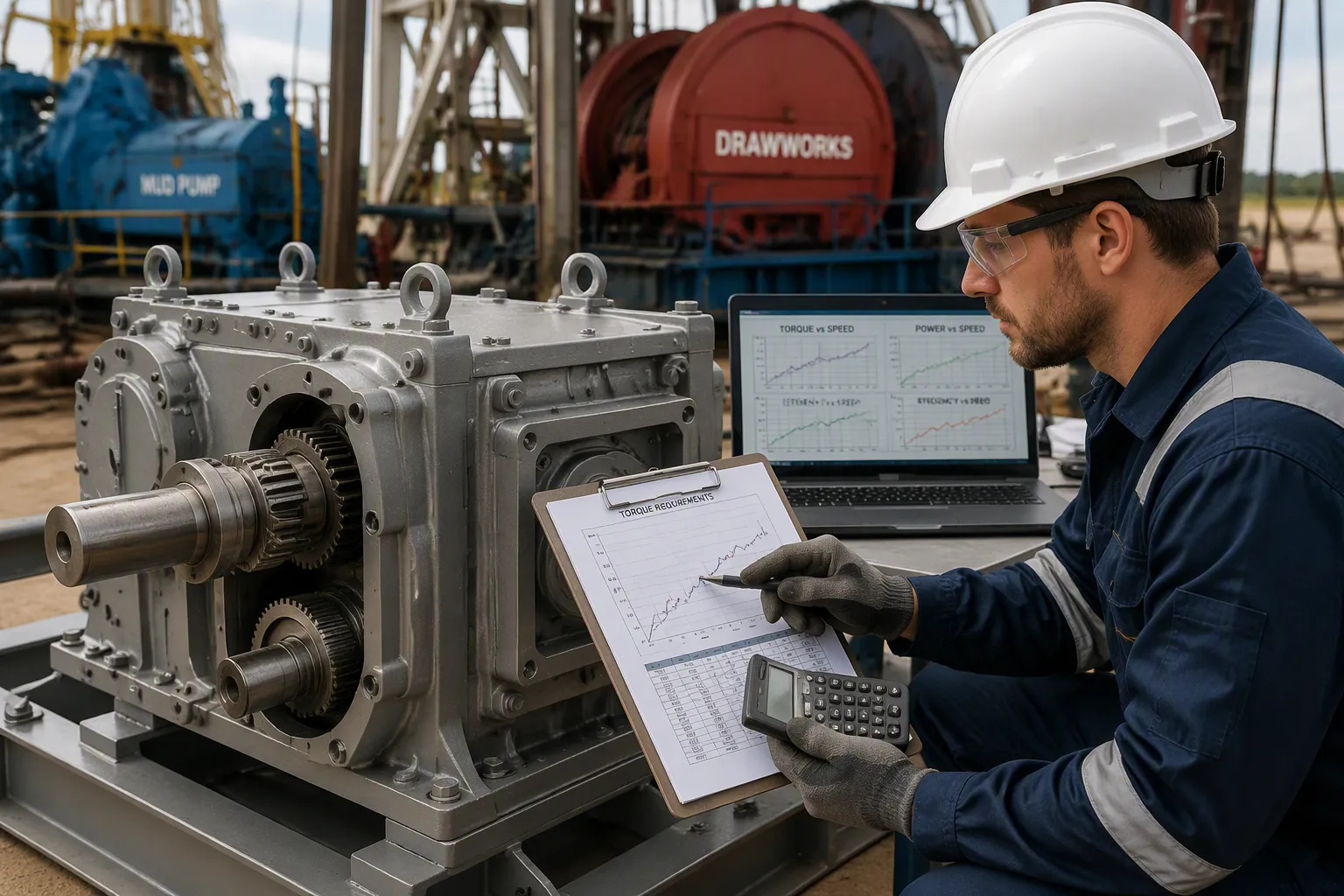
Every gearbox selection starts with a clear definition of what the unit must do. Torque to be transmitted and load to be carried are the most important parameters in gearbox selection. These two values drive every other decision, from bearing size to housing material. Engineers who skip this step risk undersizing a unit or paying for capacity they will never use.
Calculate Torque, Speed, and Power
Begin with the driven equipment. A mud pump, drawworks, or fracturing pump each has a known torque demand at its input shaft. That torque value, combined with the required output speed, defines the power the gearbox must transmit. Power equals torque multiplied by angular velocity, with torque in newton-meters and angular velocity in radians per second. The result is an average value, not a peak. Peak torque during startup or a jam can be several times higher, so the gearbox rating must account for that surge.
Speed reduction ratio follows from the input and output speed requirements. A gear reducer that turns a high-speed motor into a slow, high torque output must handle the resulting torque multiplication. For example, a 10:1 gear reducer multiplies input torque by roughly ten, minus efficiency losses. That output torque then determines shaft diameter, gear tooth geometry, and bearing selection.
Output style, shaft requirements, and mounting needs belong in this same requirements document. Does the application need a solid shaft, a hollow shaft, or a flange mount? Is the gearbox foot-mounted or shaft-mounted? These details affect alignment, footprint, and the cost of installation. A gearbox that fits the torque profile but not the mounting envelope will still fail the project.
Apply Service Factor to Load Profile
Application horsepower alone does not tell the full story. The load profile does. A conveyor that runs at steady load behaves differently from a fracturing pump that cycles between high torque demands and brief pauses. The service factor captures this difference.
Multiply application horsepower by the appropriate service factor to determine the equivalent steady state horsepower the gearbox must be rated for. A 100 hp application with a service factor of 1.5 requires a gearbox rated for at least 150 hp. The service factor comes from the application type, the hours of daily operation, and the shock characteristics of the driven load. Uniform loads use lower factors. Heavy shock loads use higher ones.
Load Type | Typical Service Factor Range |
|---|---|
Uniform, steady load | 1.0 to 1.25 |
Moderate shock | 1.25 to 1.75 |
Heavy shock | 1.75 to 2.5 |
These ranges are general guidance. Always confirm the exact factor with the gearbox manufacturer or the applicable industry standard. A high torque application with frequent starts needs a higher factor than the table suggests. The goal is simple: the selected gearbox must survive the worst load it will see, not just the average.
Document every requirement before contacting suppliers. Torque, speed, power, service factor, output style, shaft dimensions, and mounting configuration form the specification package. A complete package shortens the selection process and reduces the risk of a costly mismatch.
Evaluate Environmental Conditions
Oilfield locations expose equipment to some of the harshest conditions on earth. A gearbox that performs well in a climate-controlled plant may fail quickly in a desert, an offshore platform, or an arctic site. Environmental evaluation is not optional when specifying heavy-duty oilfield gearboxes. It directly affects reliability and service life.
Account for Temperature and Corrosion
Ambient temperature extremes change how lubricants behave. High heat thins oil and reduces its film strength. Cold thickens oil and raises the torque needed to start the gear reducer. Both conditions stress seals. Seal materials must match the expected temperature range. A seal rated for moderate climates may harden and crack in extreme cold or soften and leak in intense heat. Engineers should confirm the lubricant viscosity grade and seal compound suit the site's temperature profile.
Corrosion attacks gearbox housings, shafts, and fasteners. Saltwater, drilling chemicals, and humid air accelerate rust and pitting. Corrosion-resistant materials or protective coatings extend service life. Stainless steel shafts, epoxy coatings, and sealed enclosures resist chemical attack. The selection process should match the coating system to the specific chemicals present at the wellsite.
Protect Against Dust and Moisture
Dust and moisture ingress damage bearings and gear teeth. Fine sand particles act like grinding paste inside a gear reducer. Water contamination breaks down lubricant and promotes rust. Ingress protection ratings define how well an enclosure blocks solid particles and liquids. A higher IP rating means better sealing against dust and water jets. Sealed enclosures with proper gaskets and breathers keep contaminants out.
Breathers deserve special attention. A sealed gearbox still needs pressure equalization as internal air expands and contracts. A filter breather allows air exchange while blocking dust and moisture. Desiccant breathers remove humidity from incoming air. These small components protect the internal components and preserve performance over long service intervals.
Choose the Right Gear Reducer Type
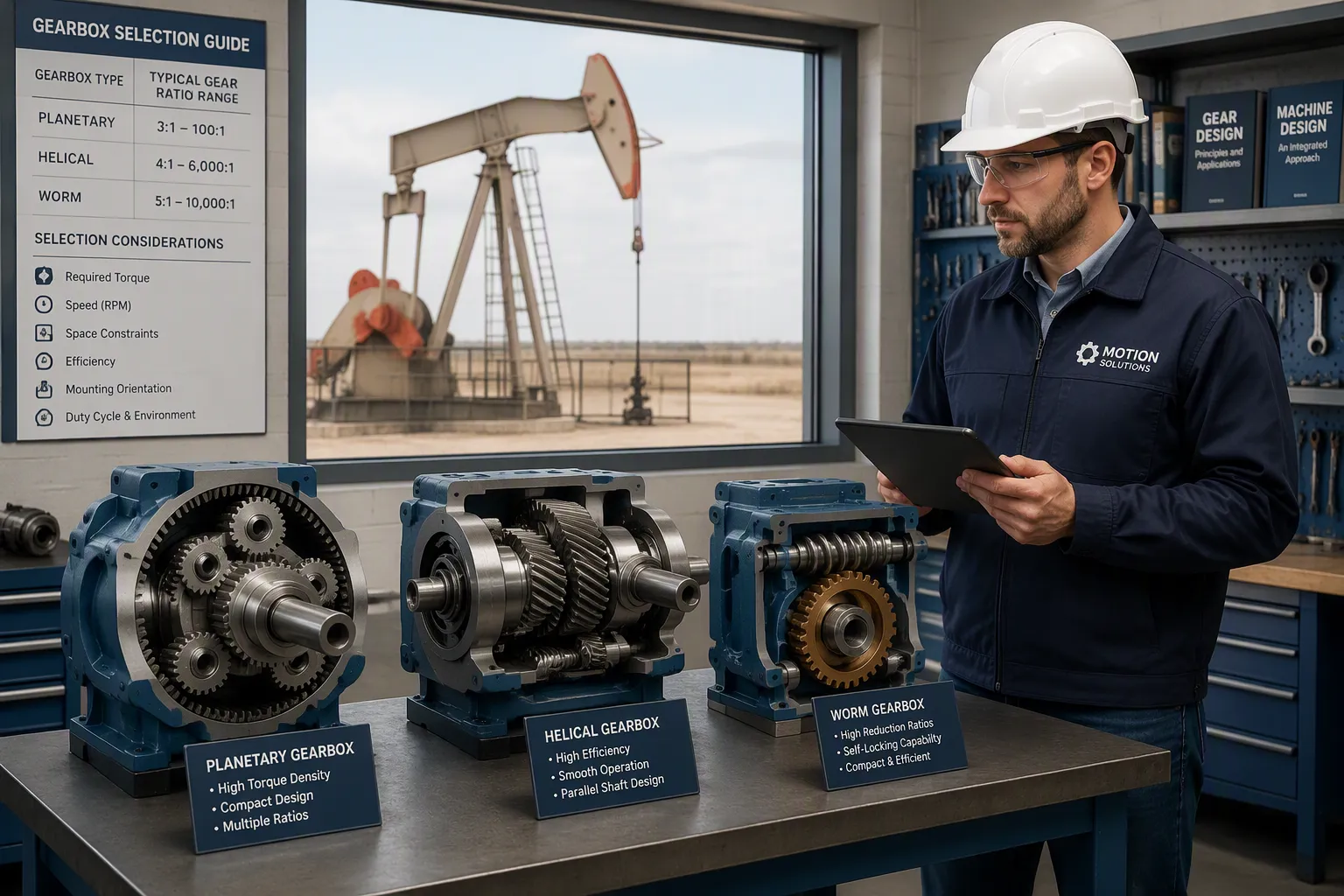
The gear reducer type determines how well the unit performs under specific load and speed conditions. Each design offers distinct advantages. Engineers must weigh gearbox efficiency, torque density, and ratio range against the demands of the application.
Compare Planetary, Worm, and Helical
Planetary gearboxes deliver high torque density in a compact design. Multiple planet gears share the load instead of a single gear. Increasing the number of planets distributes the load more uniformly. Their transmission efficiency is typically above 90% and can exceed 95%. These characteristics make planetary units popular for high-load applications such as wind turbines and heavy machinery.
Helical gearboxes are favored for high efficiency and smooth operation. They suit continuous-duty systems where reliability matters. The table below compares these two types.
Gearbox Type | Efficiency | Torque Density | Configuration Notes |
|---|---|---|---|
Helical (parallel shaft) | 96–99% per stage | Industrial workhorse | Parallel input/output shafts; helix-angle teeth for quiet, smooth operation; ratios ~1.5:1 to 250:1+ |
Planetary | 96–99% per stage | Very high — high torque from a compact package | Central sun gear, multiple planet gears, outer ring gear; concentric shafts; ratios 3:1 per stage up to 100:1+ multi-stage |
Worm gearboxes sacrifice efficiency for simplicity and space optimization. Low-ratio worm units achieve 90–98% efficiency. High-ratio worm gearboxes drop below 50% efficiency. Use a worm gearbox when its torque-to-size benefits outweigh the efficiency penalty.
If energy efficiency or continuous high-speed operation is a priority, a helical or planetary gearbox may be better.
Match Gear Reducer to Equipment
Different oilfield equipment demands different gear reducer configurations. Pumping units use gear reducer sizes from 40's to 1824's under API standards. Conventional pumping units typically operate at 64:1 gear ratios. Mark II units use 48:1 ratios. Sampson units range from 64:1 to 100:1.
Fracturing pumps require precise torque alignment. Configurable gearbox ratios align pump speed with driver torque and RPM for optimal efficiency. Poor torque/RPM alignment can leave horsepower stranded in the drivetrain. Optimized gearing converts driver output into flow and pressure while reducing mechanical stress. Lower RPM means fewer fatigue cycles and reduced wear on bearings, crossheads, valves, seats and packing.
Southdrive's flagship Fracturing Pump 2500 Type Gearbox (rated at 1865 kW) exemplifies a high-precision, heavy-duty option for demanding fracturing operations. Engineered with a robust Q235 welded steel plate housing, it handles extreme torque demands while maintaining low temperature rise and superior durability in continuous pumping environments. We also offer the Type 600 Gearbox for varied capacity needs.
Mud pumps and drawworks also require careful gear reducer selection. These applications demand robust units that withstand shock loads and continuous operation. The selection process must match the gear reducer type to the specific torque profile and duty cycle of each equipment type.
Assess Maintenance and Reliability
Evaluate Seals, Lubrication, and Serviceability
Common failure modes in oilfield gearboxes include gear tooth wear, bearing degradation, oil contamination, seal failure, and lubrication degradation. High torque applications accelerate gear tooth wear. These failures cause process-stopping breakdowns that, in extreme cases such as offshore platforms or large-scale shale operations, can cost $25,000 to $120,000 per hour of production outage. Proper reliability programs reduce unplanned downtime by 47 percent and detect 85 percent of faults before failure.
Seal selection directly affects gearbox reliability and performance. Daily visual checks catch seal wear early. Lip seals require replacement every 3 to 5 years. For critical applications handling heavy loads, upgrading to labyrinth or magnetic seals provides superior protection against dust and moisture. This matters in remote oilfield locations where immediate repairs are impossible.
Lubrication methods must match the operating environment. Oil contamination accelerates wear on bearings and gear teeth. Regular oil sampling every month or quarter detects seal and bearing degradation before catastrophic failure occurs. Serviceability matters in remote locations. Designs that simplify oil changes, filter replacements, and seal inspections without specialized tools reduce downtime. A well-maintained gear reducer operates more efficiently. Proper gearbox maintenance extends service life.
Plan for Inspections and Spare Parts
Monthly vibration checks monitor bearing condition. Bearings require replacement every 15,000 to 25,000 hours depending on load and torque conditions. Proper torque management during installation prevents bearing overload. Thermal imaging every 2 to 4 weeks adds another detection layer. These inspections transform reactive maintenance into predictive programs.
Field data from heavy-duty oilfield gearboxes deployed on 1500-hp and 2000-hp rigs shows an average mean time between failures of 18,000 operating hours for API units. This represents a 35 percent improvement over non-API units. Proper maintenance achieves this.
Spare parts availability reduces repair time by 15 to 25 percent. When parts are out of stock or incorrectly specified, teams waste 20 to 30 percent of repair time searching. Linking spare parts inventory to asset records and automating reorder points shortens mean time to repair. Higher availability directly improves overall equipment effectiveness.
Southdrive's Mud Pump Spare Parts, including Pinion Shafts and Large Gear Rings, are forged from premium alloy steels like 18CrNiMo7-6 and 20CrMnMo. They undergo rigorous carburizing, quenching, and precision gear grinding to achieve 58-62 HRC surface hardness, ensuring exceptional wear resistance and perfect gear meshing. These components support sustained gear reducer performance in demanding applications. Planning for spare parts availability before a breakdown occurs minimizes downtime and maintains production schedules. Every gear reducer benefits from a proactive spares strategy.
Ensure Compatibility and Consider Cost
Verify Mounting, Alignment, and Standards
Mounting configuration determines how the gearbox integrates with existing equipment. Foot-mounted, flange-mounted, and shaft-mounted designs each suit different installation scenarios. The mounting must match the driven equipment's interface. Shaft alignment deserves equal attention. Misalignment causes vibration, bearing wear, and premature seal failure. Laser alignment tools achieve precision that manual methods cannot match. Proper alignment extends gear reducer life and maintains performance.
Industry standards provide a framework for quality and compatibility. API Spec Q1 certification offers customers assurance that they consistently receive a quality product. Companies must submit their quality manual for approval and host an on-site audit conducted by an API official. The full system must be audited every year to ensure continued conformance. API 7K compliance matters for drilling and workover rig applications. AGMA standards govern gear design. These certifications confirm that a gearbox meets the rigorous demands of oilfield service.
Certification / Standard | Quality Assurance Mechanism |
|---|---|
ISO 9001:2015 | Documented quality-review process with quality control at every production stage |
API Standard | Compliant design for oilfield and petroleum drilling equipment |
CE Marking | EU export readiness |
SGS Inspection | Third-party verified inspection |
AGMA Standards | Gear design compliance |
API 7K | Compliant for drilling and workover rig applications |
Balance Initial Cost and Lifecycle Cost
Purchase price represents only one component of total cost. A lower-priced gear reducer may consume more energy over its service life. Efficiency losses compound across years of continuous operation. Maintenance requirements add labor and parts expenses. Downtime costs dwarf the initial price difference between a premium unit and a budget alternative.
Lifecycle cost analysis weighs efficiency, maintenance intervals, and expected service life against the purchase price. A gearbox with higher initial cost but superior efficiency and longer service intervals often delivers lower total cost of ownership. The selection process should prioritize reliability and uptime over short-term savings.
Southdrive holds ISO9001-2015, ISO14001, and ISO 45001 certifications. These credentials demonstrate compliance with quality, environmental, and safety management standards. Buyers gain confidence that the gear reducer meets international benchmarks for manufacturing excellence. Torque capacity, mounting compatibility, and lifecycle value should guide every procurement decision.
Partner with South Drive for Custom Oilfield Gearboxes
Don't let gearbox downtime compromise your drilling or fracturing operations. With over 20 years of precision manufacturing experience, South Drive offers fully customizable oilfield gearboxes and spare parts tailored to your exact torque, speed, and environmental requirements.
Contact Our Engineering Team Today for a free technical consultation, custom design evaluation, and competitive quote.
Email: info@czsouthdrive.com | WhatsApp: +86-18114306795
Selecting the right gearbox for oilfield applications follows a clear path. Define torque, speed, and power requirements first. Evaluate temperature, corrosion, dust, and moisture conditions next. Choose the gear reducer type that matches your equipment. Assess maintenance needs and spare parts availability. Verify mounting, alignment, and standards compliance. Weigh lifecycle cost against purchase price.
The right gearbox delivers total lifecycle value, uptime, and safety. Initial price alone never tells the full story. Consult manufacturers or use online selection tools to validate your calculations. Confirm compatibility with existing oilfield equipment before committing. Apply these criteria to your next gear reducer procurement decision. Your operations depend on reliable power transmission.
FAQ
What is the most important factor when selecting an oilfield gearbox?
Torque and load requirements come first. These two values drive every other decision, including bearing size, gear tooth geometry, and housing material. Engineers who skip this step risk undersizing the unit or paying for capacity the application will never use.
How does the service factor affect gearbox sizing?
The service factor adjusts application horsepower to match the actual load profile. Multiply application horsepower by the appropriate service factor to find the equivalent steady state horsepower the gearbox must handle. A 100 hp application with a 1.5 service factor needs a gearbox rated for at least 150 hp.
Which gear reducer type works best for fracturing pumps?
Fracturing pumps demand precise torque alignment and high durability. Planetary and helical gearboxes offer high torque density and efficiency above 90 percent. Southdrive's Fracturing Pump Gearboxes (including the flagship 2500 Type and Type 600 models) deliver high gear precision, good meshing, and low temperature rise for demanding fracturing operations.
How do environmental conditions affect gearbox selection?
Temperature extremes change lubricant behavior and stress seals. Corrosion from saltwater and chemicals attacks housings and shafts. Dust and moisture ingress damage bearings and gear teeth. Choose corrosion-resistant materials, proper seal compounds, and enclosures with high IP ratings to protect internal components.
What certifications should buyers look for in a gearbox supplier?
API Spec Q1 and API 7K compliance confirm a gearbox meets oilfield demands. ISO 9001:2015 demonstrates documented quality control at every production stage. Southdrive holds ISO9001-2015, ISO14001, and ISO 45001 certifications, showing compliance with quality, environmental, and safety management standards.
Please Contact Us!


Recent News
1.See you at Hannover Messe 2026! Our booth number is Hall 17 F70-18
2026-04-242.Southdrive Official New Website Officially Launched
2026-05-093.We are Exhibiting at Hannover Messe 2026
2026-05-084.Heavy-Duty Mining Gearboxes: Built for Extreme Loads
2026-08-185.What Are Fracturing Pump Gearboxes in the Oil Industry?
2026-08-05