Low-Pressure vs Gravity Casting for Pumps & Intercoolers
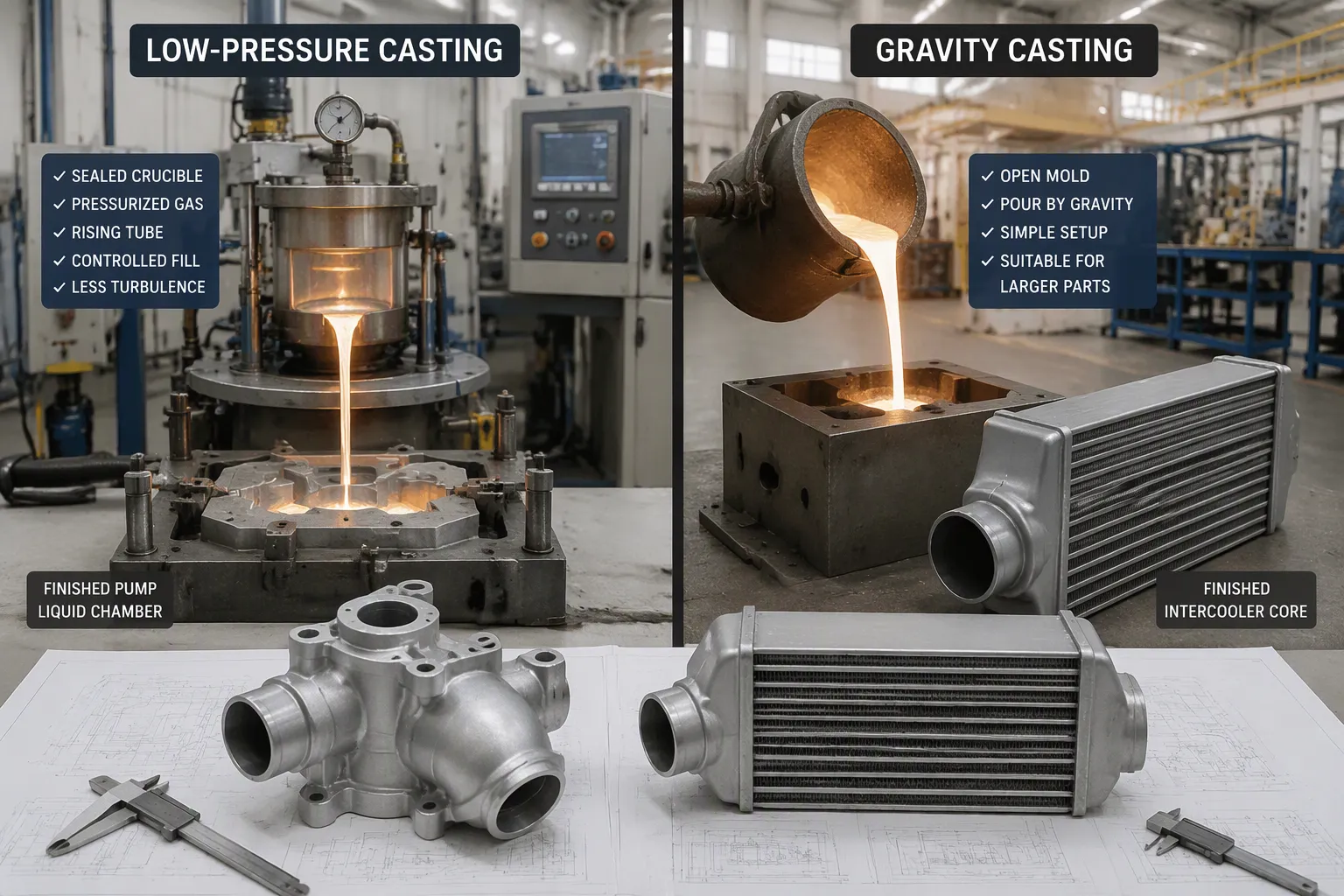
Low-pressure aluminum casting is the better choice for pump liquid chambers and intercoolers. This method delivers superior pressure tightness, lower porosity, and precise thin-wall control. These three qualities directly determine leak resistance and thermal performance in demanding fluid-handling components. Low-Pressure vs. Gravity Aluminum Casting differ in mold filling, solidification behavior, and final part density. This comparison examines quality, mechanical performance, design flexibility, production cost, and ideal applications. Engineers and buyers can then match the right process to each component's requirements.
Key Takeaways
Low-pressure casting creates stronger, leak-proof parts for pump liquid chambers and intercoolers.
Gravity casting works for simple parts that do not hold pressure.
Low-pressure casting saves money over time with less scrap and fewer failures.
Choose low-pressure casting when you need thin walls and complex internal passages.
Low-Pressure vs. Gravity Aluminum Casting: Core Differences
How Each Method Fills the Mold
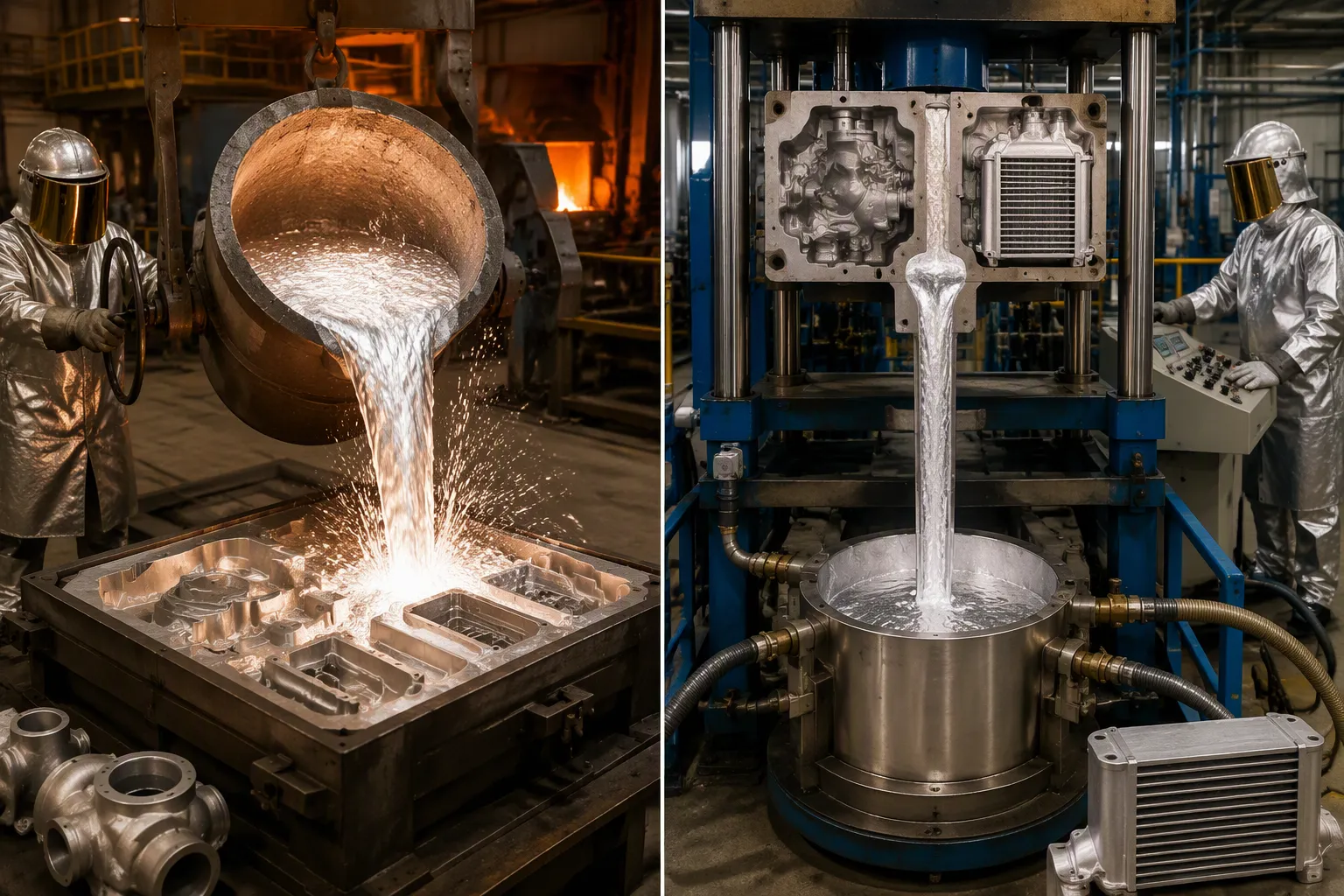
The filling mechanism separates these two processes at the most fundamental level. Gravity casting pours molten aluminum into the mold from above. The metal falls downward and fills the cavity under Earth's gravity alone. This approach is simple and direct. It also introduces turbulence as the liquid metal splashes against mold walls and internal cores.
Low-pressure casting works differently. A sealed crucible holds the molten aluminum. Dry, clean compressed air pushes the metal upward through a riser pipe and into the mold cavity. This slow, controlled rise produces turbulence-free filling. Oxide inclusions and gas entrapment are minimized as a result. The pressure stays on until the casting solidifies completely.
The table below summarizes the core process differences between Low-Pressure vs. Gravity Aluminum Casting.
Aspect | Low-Pressure Aluminum Casting | Gravity Aluminum Casting |
|---|---|---|
Filling mechanism | Molten aluminum pushed upward from holding furnace through riser using dry, clean compressed air | Molten metal poured into mold, fills under Earth's gravity |
Pressure during filling/solidification | Maintained pressure until casting solidifies | No external pressure; relies only on gravity |
Casting quality | Good filling, less shrinkage, high compactness | Not pressure-assisted; less suitable for thin walls |
Material utilization | Suitable for thin-walled castings; riser uses very little material | Not suitable for thin-walled castings; risers must be added |
Worker environment | Mostly mechanized; intelligent working environment is good | Some workers needed to assist with pouring |
Solidification and Density Outcomes
Solidification behavior determines the internal quality of the final part. In low-pressure casting, gas pressure remains on the liquid metal surface inside the sealed crucible. This pressure feeds metal into the mold as shrinkage occurs. The result is a dense casting structure with fewer internal pores. Shrinkage is well compensated throughout the cooling phase.
Gravity casting offers no sustained pressure during solidification. The metal cools and contracts without additional feed metal pushing into the mold. This produces castings with lower density and slightly poorer strength. Internal porosity becomes more likely, especially in complex geometries with varying wall sections.
These differences matter greatly for pump liquid chambers and intercoolers. Both components must contain fluids or gases under pressure. Internal porosity creates leak paths that lead to premature failure. A dense, pressure-tight structure is essential for reliable performance. Low-pressure casting delivers this density through its pressure-fed solidification. Gravity casting struggles to match this level of internal integrity in demanding fluid-handling applications.
Part Quality and Porosity
Low-Pressure Porosity Control
Low-pressure casting reduces gas entrapment and porosity through its controlled filling method. Molten metal enters the mold from the bottom or side at a slow rate. The metal rises upward as a coherent mass with minimal exposed surface area. This gentle rise limits reactions with the environment. Hydrogen pickup drops, and oxide films stay on casting surfaces rather than folding into the interior. Internal defects such as gas porosity and entrapped inclusions are minimized as a result.
Melt refining and filtration further lower baseline porosity. Dissolved hydrogen, oxide films, and non-metallic inclusions are primary causes of gas porosity. Degassing processes such as rotary degassing and ceramic foam filtration reduce hydrogen content and melt contamination. Clean melt combined with low-turbulence filling produces internal soundness. For pump liquid chambers and intercoolers, this means fewer leak paths and fewer machining problems when internal passages are cut open.
Gravity Casting Porosity Risks
Gravity die casting is more prone to internal porosity and oxide inclusions, especially in complex geometries. The pouring action creates turbulence that folds aluminum oxide skin and traps air bubbles. These bubbles solidify into permanent voids. Abrupt changes in section thickness make the problem worse. Thin sections freeze fast while thick regions stay molten longer, forming shrinkage porosity. Heavy bosses and isolated lugs act as liquid pockets that cannot be fed.
Venting limitations compound these issues in gravity casting. Standard venting cannot evacuate air fast enough from complex cavities, which leads to gas porosity when molten aluminum traps remaining air pockets. Complex geometries create turbulence that folds oxide skin and traps air bubbles into permanent voids. For pump liquid chambers and intercoolers, internal porosity directly causes leaks under pressure. Machining operations may also expose subsurface voids, turning a seemingly good casting into scrap. The table below summarizes common defects in gravity die cast aluminum.
Defect | Morphology | Typical Location | Cause |
|---|---|---|---|
Gas porosity | Rounded, smooth voids | Beyond final fill front | Trapped air, ineffective venting, dissolved hydrogen |
Shrinkage porosity | Irregular, sponge-like cavities | Thermal hot spots, heavy bosses | Region contracts without liquid feeding |
Oxide inclusion | Film or folded skin | Turbulent flow regions | Melt cleanliness, transfer, turbulence |
Mechanical Properties and Pressure Tightness
Tensile Strength and Leak-Proofing
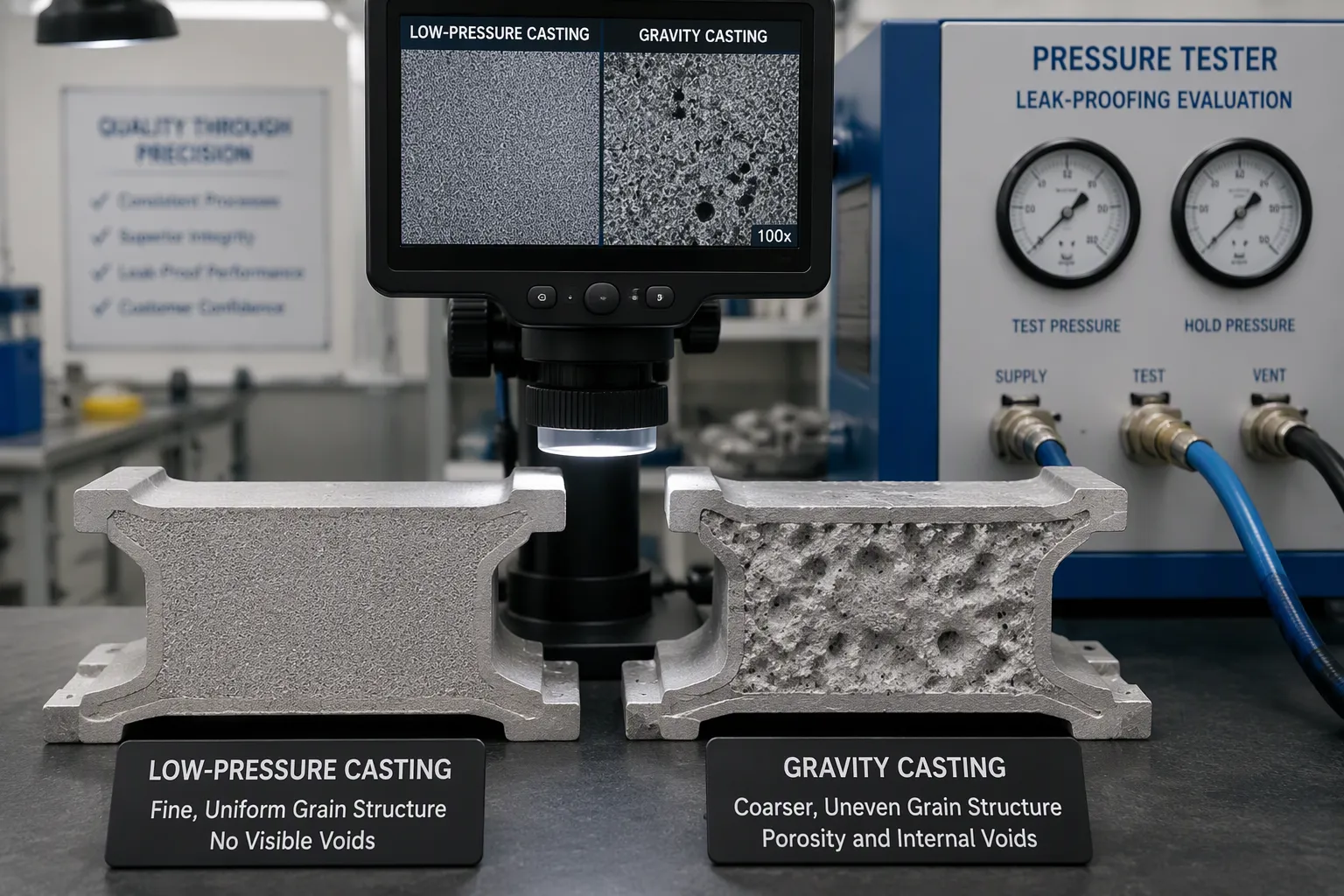
Low-pressure casting produces a finer grain structure. The pressurized fill and controlled solidification produce smaller, more uniform grains throughout the casting. Grain boundaries act as barriers to crack propagation. A finer grain structure means more boundaries per unit volume. This restricts dislocation movement and raises the material's resistance to deformation. The result is a stronger, more ductile aluminum part.
Gravity casting produces a coarser grain structure. The slower, less controlled cooling allows grains to grow larger. Larger grains reduce the total boundary area. Mechanical strength drops as a result. The difference becomes significant in thin sections and complex geometries. These areas cool at different rates and develop uneven grain sizes. The final part may have weak zones that fail under pressure.
Leak-proofing depends on internal soundness. A casting with internal porosity cannot hold pressure reliably. Gas or liquid finds paths through interconnected voids. Low-pressure casting minimizes these paths through its pressure-fed solidification. The sustained pressure pushes feed metal into shrinking regions. Voids close before they become permanent defects. The table below compares the mechanical outcomes of Low-Pressure vs. Gravity Aluminum Casting.
Property | Low-Pressure Casting | Gravity Casting |
|---|---|---|
Tensile strength | Higher, from finer grain structure | Lower, variable by section |
Grain structure | Fine and uniform | Coarser, uneven in complex parts |
Internal porosity | Minimized by pressure feeding | More likely, especially in thick sections |
Leak resistance | High in pressure-tight components | Prone to leaks in complex passages |
Material Standards and Testing Requirements
To guarantee pressure tightness for pump liquid chambers and intercoolers, manufacturers must adhere to strict material and testing standards. The table below outlines the typical specifications for premium A356 aluminum alloy castings produced via low-pressure casting.
Specification / Test | Low-Pressure Casting Standard (e.g., A356-T6) | Why It Matters for Fluid Components |
|---|---|---|
Tensile Strength | ≥ 260 MPa (ASTM B26) | Prevents structural cracking under high internal fluid pressure. |
Yield Strength | ≥ 180 MPa | Ensures the liquid chamber resists permanent deformation during pump cycling. |
Elongation | ≥ 5% | Provides necessary ductility to absorb vibration and thermal shock. |
Hydrostatic Testing | 375 psi (2.58 MPa) for Liquid Chambers / 0.06 MPa for Intercoolers | Guarantees zero leakage by exposing micro-porosity before machining. |
Why Liquid Chambers and Intercoolers Need Density
Pump liquid chambers and intercoolers share a critical requirement. Both must contain fluids or gases under pressure without leaking. A pump liquid chamber holds process fluid that may be corrosive or hazardous. An intercooler channels charge air that must not escape into the engine bay. Any internal porosity creates a potential leak path. A single interconnected void can allow fluid to seep through the casting wall over time.
Density directly determines pressure tightness. A dense casting has fewer internal voids and fewer paths for fluid migration. Low-pressure casting delivers this density through its pressure-fed solidification. The riser pressure remains on the metal until the casting freezes completely. Shrinkage porosity cannot form because feed metal fills every shrinking region. The result is a structure that holds pressure reliably across the component's service life.
Gravity-cast aluminum can be more prone to leaks in complex internal passages. Intercoolers have intricate charge-air channels with thin walls between them. Gravity casting struggles to fill these thin sections without turbulence and oxide entrapment. The resulting porosity may not appear during initial inspection. It can open into a leak after machining or after thermal cycling in service. Pump liquid chambers face similar risks. Their internal passages and mounting bosses create hot spots where shrinkage porosity forms. A leak in a pump liquid chamber can cause fluid loss, environmental damage, or safety hazards. A leak in an intercooler reduces engine efficiency and may trigger diagnostic faults. Density is not optional for these components. It is the foundation of reliable performance.
Design Flexibility and Wall Thickness
Complex Internal Passages in Intercoolers
Intercoolers rely on intricate charge-air channels to transfer heat efficiently. These internal passages must be narrow, uniform, and free of blockages. Low-pressure casting supports this level of complexity. The slow, pressurized fill allows molten aluminum to reach deep into thin cores without turbulence. The metal rises smoothly and fills every channel before solidification begins. This capability is critical for intercooler charge-air coolers, where passage geometry directly affects cooling performance.
Gravity casting struggles with these intricate internal passages. The pouring action creates turbulence that traps air and oxide films inside narrow channels. These defects restrict airflow and reduce heat transfer. Complex core structures also increase the risk of incomplete filling. The Low-Pressure vs. Gravity Aluminum Casting comparison shows a clear advantage for low-pressure methods in intercooler production. Gravity casting remains better suited to simpler geometries with thicker walls and fewer internal features.
Thin-Wall Limits for Liquid Chambers
Wall thickness directly affects heat transfer and pressure containment in pump liquid chambers. Thinner walls improve heat dissipation and reduce component weight. They also lower material costs. Low-pressure casting achieves thinner walls without sacrificing structural integrity. The pressurized fill and pressure-fed solidification produce dense, leak-free walls even in reduced sections. This allows engineers to design liquid chambers with optimized wall profiles.
Gravity casting imposes practical limits on minimum wall thickness. The lack of sustained pressure during solidification means thin sections may not fill completely. Shrinkage porosity becomes more likely as wall thickness decreases. Designers must compensate by adding material, which increases weight and cost. For pump liquid chambers, thicker walls reduce thermal efficiency and add unnecessary bulk. Low-pressure casting removes these constraints and gives engineers greater freedom to optimize wall thickness for both performance and weight.
Production Efficiency and Cost
Cycle Times and Tooling Investment
Regulated pressure of 20–100 kPa forces molten aluminum upward into the mold. This bottom-up filling keeps flow laminar and solidification progressive. Gas entrapment and oxide inclusions rarely form. Fewer defective castings reduce rework and raise effective throughput.
Tooling is more complex. Low-pressure die casting requires permanent steel dies, a sealed furnace, a riser tube, pressure control, and a clamping system. That equipment is capital-intensive. The riser tube sits in molten metal every cycle, so erosion is constant and maintenance is mandatory. Gravity casting uses simpler gravity-fill equipment, which costs less to buy and run. Die life is not quantified in evidence, but permanent steel dies need costly rework after design changes.
Common production metrics make the difference clear.
Production Efficiency Metric | Low-Pressure Casting | Gravity Casting |
|---|---|---|
Casting yield | 85–90% | 60–75% |
Porosity-related rejection share | Reduced | ~30–40% of rejections |
Gating/riser waste | Minimized | Extensive |
Machining requirements | Reduced | Higher |
Casting yield alone separates the processes. Low-pressure uses 85–90% of the metal poured; gravity uses only 60–75%. Less gating waste means less scrap. Lower porosity means fewer machining failures.
When Gravity Casting Makes Economic Sense
When comparing Low-Pressure vs. Gravity Aluminum Casting, the decision starts with tooling budgets, but total cost depends on long-run yield. Low-pressure casting can reduce overall costs by 20 to 35 percent compared with gravity casting while improving reliability. That saving comes from lower scrap, fewer machining operations, and fewer warranty failures. For pump liquid chambers and intercoolers, these gains connect directly to pressure tightness.
Gravity casting remains viable in a narrow niche. Simple geometries with thick walls and no pressure requirement can be poured with cheaper equipment. Low tooling investment suits short runs. The process creates more turbulence and lower mechanical properties. In a liquid chamber or intercooler, up to 30–40% of gravity-casting rejections relate to porosity. That failure rate cancels the tooling saving. As volume rises, low-pressure casting becomes cheaper because scrap and rework drop. The most economical method produces sound parts at the lowest final cost, not the lowest starting price.
Best-Fit Applications for Each Method
Application requirements decide the final method. A pressure-retaining intercooler needs a different approach than a simple mounting bracket. The choice between Low-Pressure vs. Gravity Aluminum Casting rests on how much internal soundness a part must deliver. Low-pressure casting takes over whenever safety or leak-tightness matters.
Where Low-Pressure Casting Wins
Low-pressure casting owns safety-critical castings. It is the most common process approved for aluminum wheels, pump liquid chambers, and intercoolers. These parts face pressure, vibration, and thermal cycling. A single internal void can become a leak path. Low-pressure filling rises at a slow, steady rate. Oxide films stay on the surface. Pressure remains on the riser until the casting solidifies. The finished part has a denser structure with fewer interconnected pores. Designers can then specify thinner walls and complex internal passages without adding porosity risk.
Southdrive manufactures heavy-duty truck intercoolers, diaphragm pump spare parts, and custom aluminum castings for global OEMs. Our manufacturing process integrates advanced quality control at every stage. We utilize spectrometers for real-time alloy composition analysis before pouring, ensuring strict adherence to ASTM standards. Post-casting, every liquid chamber undergoes a 100% hydrostatic test at 375 psi (2.58 MPa) to guarantee zero leakage, while intercoolers are tested at 0.06 MPa. Furthermore, our 30+ engineering team employs DFM (Design for Manufacturability) analysis to optimize gating systems, further minimizing shrinkage porosity in complex thin-wall designs. All processes are strictly governed by our ISO9001-2015, ISO14001, and ISO 45001 certifications, ensuring traceable records and consistent pressure tightness that drastically reduces warranty failures in the field.
Where Gravity Casting Remains Viable
Gravity casting still earns a place for non-pressure parts with simple geometries. A bracket, a cover, a non-structural housing can tolerate the lower density and coarser grain. Tooling costs stay low. Short runs become economical when production volume cannot justify low-pressure dies. Thick walls and generous radii hide the effects of turbulent filling. This method produces acceptable parts where internal soundness is not critical.
The method falls short for pump liquid chambers and intercoolers. Gravity pouring creates turbulence and entrains oxides. Shrinkage pores form at hot spots that remain liquid after neighboring sections freeze. For a component holding fluid or compressed air, these defects create leak paths. Comparisons of the two processes make the tradeoff clear. The cheaper tooling cannot offset the cost of scrap, rework, and field failures. Gravity casting remains a practical choice only when the application does not demand pressure tightness.
Low-pressure casting remains the better fit for pump liquid chambers and intercoolers. It delivers pressure tightness through reduced porosity and precise control of thin walls. These qualities lower rejection rates and total cost despite higher tooling investment.
Gravity casting keeps value for simple, non-pressure components. Its turbulence and shrinkage porosity create leak paths in complex passages, so it cannot match the reliability these parts demand. Standard gravity tooling remains viable for short runs of simple brackets or housings.
Selecting the right method starts with performance requirements. When a component must contain fluid or compressed air without leaking, the Low-Pressure vs. Gravity Aluminum Casting comparison points decisively to low-pressure.
FAQ
Which process should I choose for a pressure-tight pump liquid chamber?
Low-pressure casting is the safer choice. It keeps pressure on the metal until solidification ends. That combination minimizes porosity and leak paths. Gravity casting suits simple, non-pressure parts instead.
Can gravity casting ever meet intercooler requirements?
Rarely. Intercoolers contain narrow charge-air passages that demand complete, turbulence-free filling. Gravity pouring introduces oxide inclusions and shrinkage pores in these thin sections. A gravity-cast intercooler may pass initial inspection and still leak after machining or thermal cycling. Low-pressure casting remains the approved route for this component class.
How much does low-pressure casting actually cost compared with gravity casting?
The tooling carries a higher upfront price. Total cost tells a different story. Low-pressure die casting can cut costs by 20% to 35% while improving reliability. Casting yield reaches 85–90%, against 60–75% for gravity. Lower scrap and fewer machining failures offset the initial investment.
What is the minimum wall thickness for each method?
Low-pressure casting supports thinner walls because pressurized fill and pressure-fed solidification keep reduced sections dense and leak-free. Gravity casting needs extra material to compensate for incomplete filling and shrinkage porosity. For liquid chambers, thinner walls improve heat dissipation and cut weight.
What should I verify in a supplier for these castings?
Look for documented process control across melt, fill, and solidification. Southdrive manufactures heavy-duty truck intercoolers, diaphragm pump spare parts, and custom aluminum castings under ISO9001-2015, ISO14001, and ISO 45001 certifications. Traceable records and consistent pressure tightness reduce warranty failures in the field.
Need Pressure-Tight Aluminum Castings for Your Next Project?
Whether you need high-strength pump liquid chambers or leak-proof heavy-duty intercoolers, Southdrive's engineering team is ready to optimize your design for low-pressure casting. Get a custom quote and DFM analysis within 24 hours.
Request a Custom Quote