Industrial Gearbox Applications: Oil, Gas, Marine
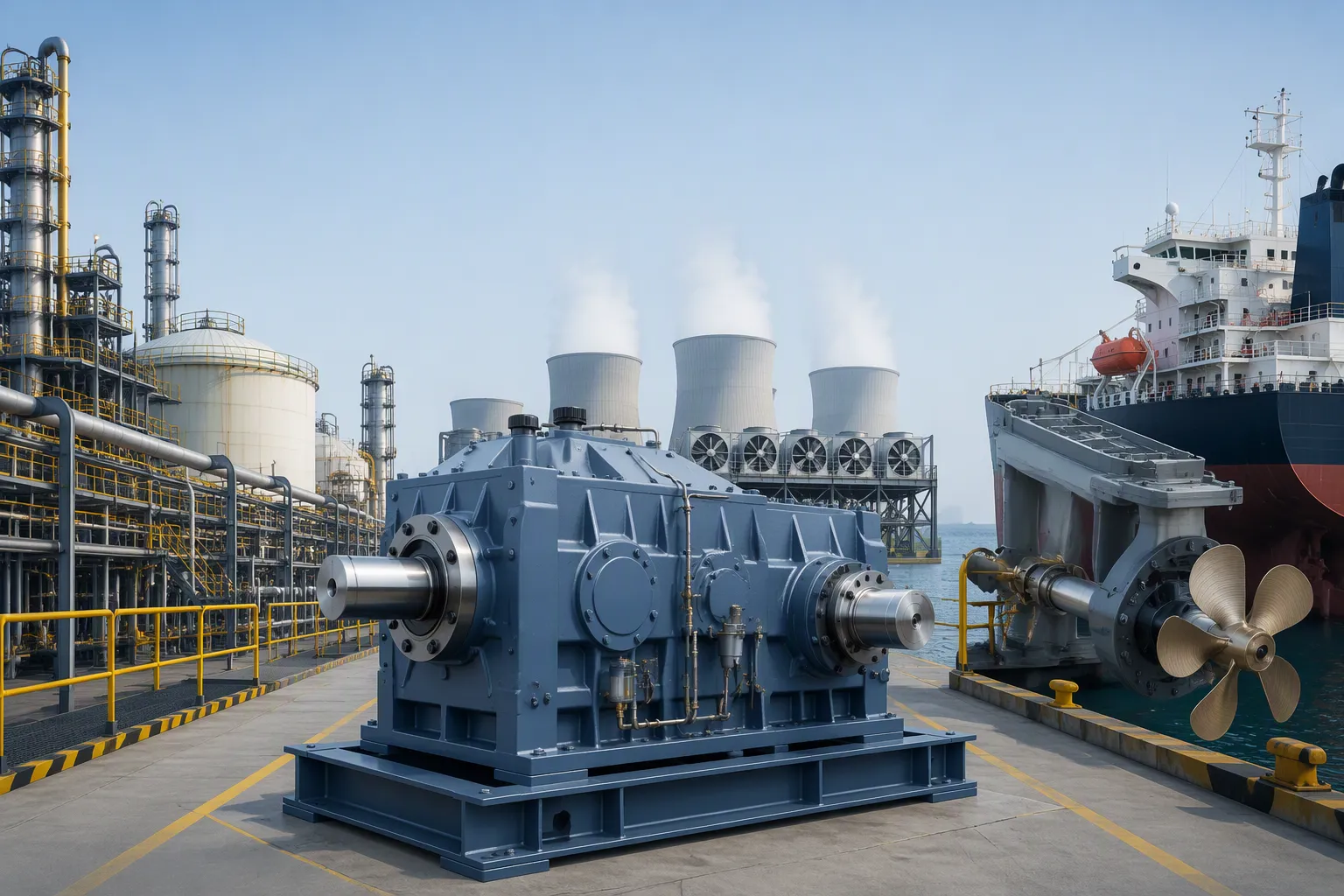
Industrial gearboxes are critical components that convert torque and control speed in some of the world's most demanding applications. They keep drilling rigs rotating, marine propellers turning, and cooling tower fans moving at the right speed. Reliability, efficiency, and durability are their core benefits.
Drilling operations rely on gearboxes to match motor output to heavy pumping loads. Marine vessels use them for propulsion and steering under variable sea conditions. Cooling tower systems use gearboxes as speed reducers between motor and fan.
Those three sectors sit at the heavy end of the industrial gearbox market, and each one loads a drive train differently. Oil and gas demands extreme torque and strict certification. Marine duty adds corrosion, shock loading, and constant speed variation. Cooling tower duty means continuous operation at high ambient temperature with almost no tolerance for unplanned downtime. This guide breaks down what each duty actually requires, and how to select and maintain a gearbox that lasts in all three.
Key Takeaways
Industrial gearboxes are vital for oil and gas, marine, and cooling tower systems.
Choose gearboxes based on torque, speed, duty cycle, and environment.
Regular maintenance like oil analysis and vibration monitoring prevents failures.
Certified manufacturing and full material traceability protect long-term reliability.
Industrial Gearbox Applications in Oil & Gas
Few industries punish gearbox failure as quickly as oil and gas extraction. A gearbox matches motor speed to the load requirements of heavy machinery. Applications in this sector demand hard-wearing materials and strict certification.
The duty is unforgiving: high torque, near-continuous operation, and sites where an unplanned stop costs far more than the component itself. That is why operators specify case-hardened alloy steels, controlled heat treatment, and full material traceability instead of buying on price alone.
Drilling Rigs and Mud Pumps
Mud pumps circulate drilling fluid downhole and return cuttings to the surface. Gearboxes convert the motor's high-speed rotation into the slower, high-torque motion these pumps require.
Southdrive's Fracturing Pump Type 600 Gearbox shows what this duty demands. It has a rated power of 448 kW and a speed ratio of 4.61:1. Its housing is welded from Q235 steel plate, and its gears are cut from 18CrNiMo7-6 alloy steel. Hobbing, carburizing and quenching, and precision grinding create a hard surface and a tough core. For a wider look at how these units are specified, see our guide to fracturing pump gearboxes in the oil industry.
Mud pump spare parts follow the same material discipline. Southdrive's pinion shafts and gear rings use 20CrMnMo alloy steel. Carburizing and quenching give high hardness and wear resistance. Each part carries an engraved model and serial number, so its heat-treatment record can be traced back to the individual component.
Compressors and Pipeline Pumps
Electric motor-driven compressors often need step-up gearboxes. These units raise motor speed from 1,800–3,600 RPM to over 15,000 RPM for compressor impellers. API 613 covers special-purpose gear units for petroleum, chemical, and gas industry services, while API 677 covers general-purpose gear units.
These trains run continuously, so reliability matters more than first cost. A single unplanned trip can interrupt an entire process line, which is why operators specify gear units with documented inspection records and a proven service history in similar duty.
A refinery example shows the value of matching the drive to the duty. Off-gas compressors at the SATORP refinery in Al Jubail needed stepless variable speed control. Steam turbines were rejected over condenser and water supply costs, and variable frequency drives required large air-conditioned buildings. Engineers instead chose a hydrodynamic variable speed planetary gear. It provided stepless speed variation and progressive torque toward low speed, and it integrated the gearbox, lube oil system, and cooler in a single unit. Hydrodynamic variable speed drives built on the same principle now serve multi-megawatt compressor and pump trains.
Industrial Gearbox Applications in Marine Systems
Marine environments are unforgiving. Salt spray, heavy loads, and variable speeds test every component. Applications in this sector must deliver reliable torque under conditions that change without warning.
Propulsion Systems and Reduction Gears
Propulsion gearboxes match engine speed to propeller requirements. Reduction ratios vary by vessel type. Lighter, faster boats use ratios from 1.5:1 to 2:1. Cruising and semi-displacement boats use 2:1 to 3:1. Heavier displacement hulls, trawlers, and commercial vessels use 3:1 and higher for slow, powerful propeller rotation. The trade-off between these arrangements is covered in our comparison of 1-speed versus 2-speed marine gearboxes.
The global marine gearbox market was valued at USD 1.77 billion in 2026 and is projected to reach USD 2.75 billion by 2033, according to Coherent Market Insights. Offshore support vessels and hybrid-electric propulsion systems are among the demand drivers.
Corrosion resistance requires multiple defenses. Super-duplex stainless steels and nickel-aluminum bronze alloys protect critical components. Thermal-sprayed aluminum and zinc-rich primers add protective coatings. Advanced sealing systems prevent saltwater ingress. Marine-grade lubricants with corrosion inhibitors form protective films on metal surfaces.
Transient loads from wave impacts and sudden course corrections create torque spikes. Designers incorporate oversized bearings and gears rated above expected loads. Torque-limiting couplings and soft-start systems reduce shock.
Southdrive's Klingelnberg spiral bevel gears meet these demands. They achieve Grade 3 precision on Klingelnberg C100U CNC machines. Hard skiving processing creates quiet operation and strong load capacity for marine gearboxes. We explain why that process matters in our article on how hard skiving reduces NVH in Klingelnberg spiral gears.
Winches and Steering Gear Drives
Deck machinery relies on gearboxes for controlled motion. Winches handle mooring lines and cargo. Steering gear drives translate control inputs into rudder movement. Both applications need reliable torque under variable sea conditions, and both benefit from the same equal-height spiral bevel geometry used in propulsion trains.
Precision gearing also determines how quietly and how precisely a vessel responds to the helm. Grade 3 tooth accuracy on the C100U machines keeps meshing smooth through long duty cycles, frequent direction changes, and continuous load conditions. Our marine gear solutions are built around this gearing for workboats, fishing vessels, ferries, and commercial craft.
Seals must remain resilient against oil, seawater, vibration, and movement. Integrated monitoring systems detect early signs of corrosion and enable predictive maintenance.
Industrial Gearbox Applications in Cooling Tower Systems
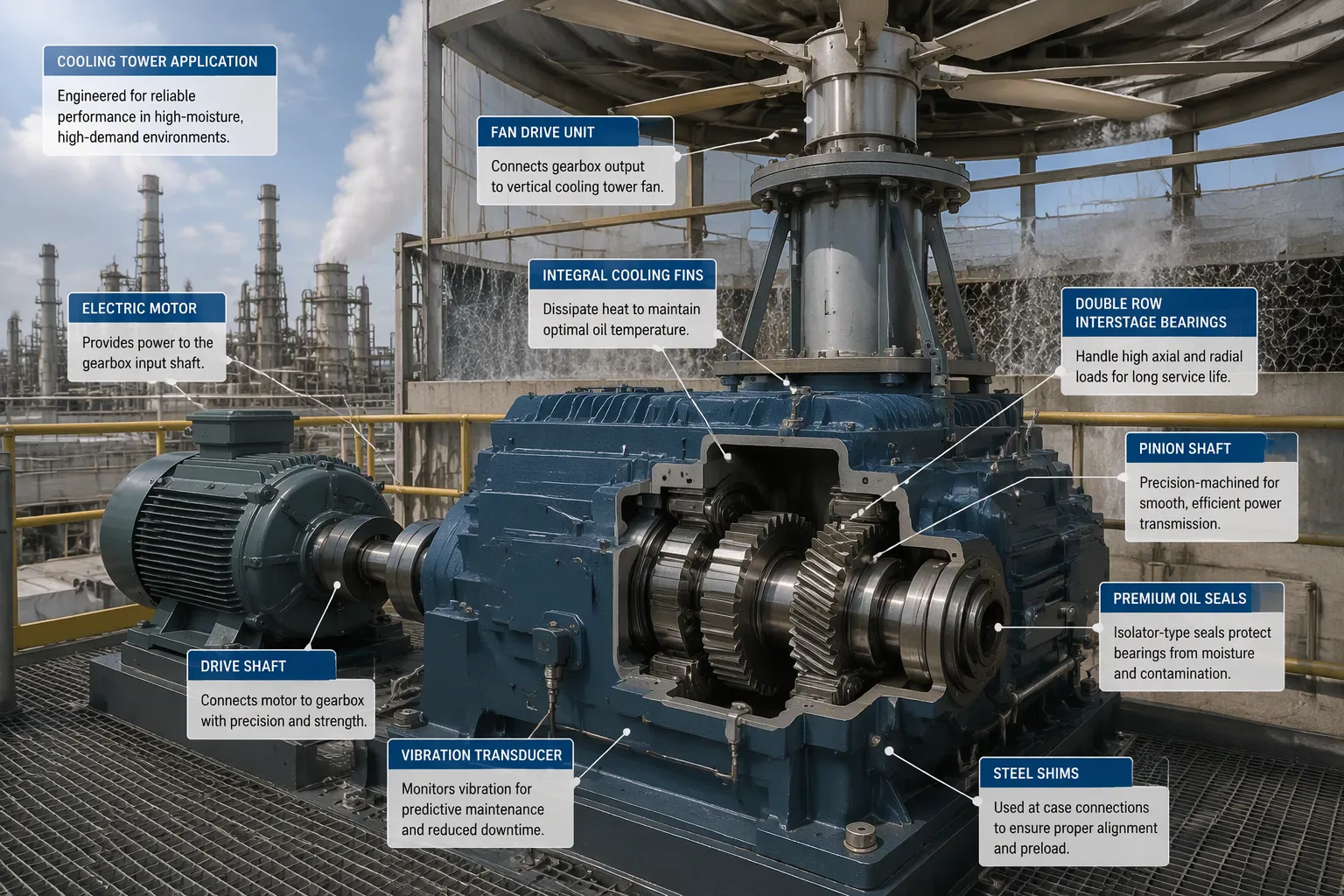
Cooling tower gearboxes act as speed reducers between the motor and fan. They ensure efficient airflow for heat rejection in power generation, chemical processing, metals, and water infrastructure. These industrial gearbox applications face demanding operating conditions, including moisture, heat, vibration, and changing fan loads.
Fan Drive Units for Airflow Control
Fan drive units must handle high operating temperatures and constant vibration. Gear drive housings with integral cooling fins increase surface area for better heat rejection. Large internal oil ports improve oil circulation. These features extend oil life, reduce oil change frequency, and ensure proper gear and bearing lubrication.
Excessive sound and vibration require robust metal castings. These castings minimize case deflection under high torque and thrust loads. Castings up to 40% thicker than standard reduce metal fatigue and extend service life, and the same casting discipline is what keeps porosity and dimensional drift under control in lightweight aluminum castings. Steel shims at case connection points replace plastic shims, which can creep and alter tolerances under extreme temperature and humidity.
Premature bearing failure and pinion shaft wear demand heavy-duty double row interstage bearings with 100,000-hour bearing life. Premium-grade isolator-type bearing oil seals with a fixed stator sealing surface replace lip seals. Built-in vibration transducer mounting enables condition monitoring for early detection of wear or eccentricity.
Condition | Design / Material Response | Expected Benefit |
|---|---|---|
High operating temperatures | Integral cooling fins; large internal oil ports | Extends oil life; ensures proper lubrication |
Excessive sound and vibration | Castings up to 40% thicker than standard | Quieter operation; reduced metal fatigue |
Extreme temperature and humidity | Steel shims instead of plastic shims | Maintains gear settings; controls noise |
Premature bearing failure | Double row interstage bearings (100,000-hour life) | Protects against premature wear |
Water Circulation and Pump Drives
Monitoring protects these systems from sudden failure. Operators should track gear mesh frequencies and sidebands to detect early wear or eccentricity, and combine vibration data with oil analysis to identify ferrous debris before damage spreads. On the fan and shaft, watch for bending modes and resonance, especially on long vertical shafts. Verify blade balance after cleaning or replacement, and confirm bearing lubrication and cooling, since tower humidity accelerates wear. Cooling towers rarely stop without warning. In most cases the first signal is a change in vibration or oil chemistry, which makes condition monitoring the cheapest reliability tool on site.
Selecting and Maintaining Industrial Gearboxes
Torque, Speed, and Load Requirements
Torque is the primary sizing criterion, not horsepower alone. A gearbox selected by power rating can miss real load resistance from friction, acceleration, and external shaft forces. Engineers should calculate output torque from load weight, resistance, and acceleration before choosing a gear ratio, then confirm the selected unit is rated above the required continuous output torque. Our guide to selecting a gearbox for oilfield applications walks through the same calculation for pump and rig drives.
Speed, duty cycle, and environment then refine the choice. The four factors below decide the final rating, ratio, and protection package.
Sizing Factor | Influence on Selection |
|---|---|
Torque | Must exceed continuous output torque; size for peak and starting loads |
Speed | Sets gear ratio and torque multiplication |
Duty cycle | Continuous duty requires larger ratings than intermittent use |
Environment | Drives seal, coating, and lubricant choices |
For harsh or corrosive environments, material choices protect performance. Stainless steel or bronze gears resist corrosion. Stainless steel or ceramic bearings handle seawater exposure. Marine-grade aluminum or stainless steel housings prevent degradation. Double-lip oil seals, sealed breathers, and synthetic lubricants extend service life in high-moisture conditions.
Maintenance Strategies for Long Service Life
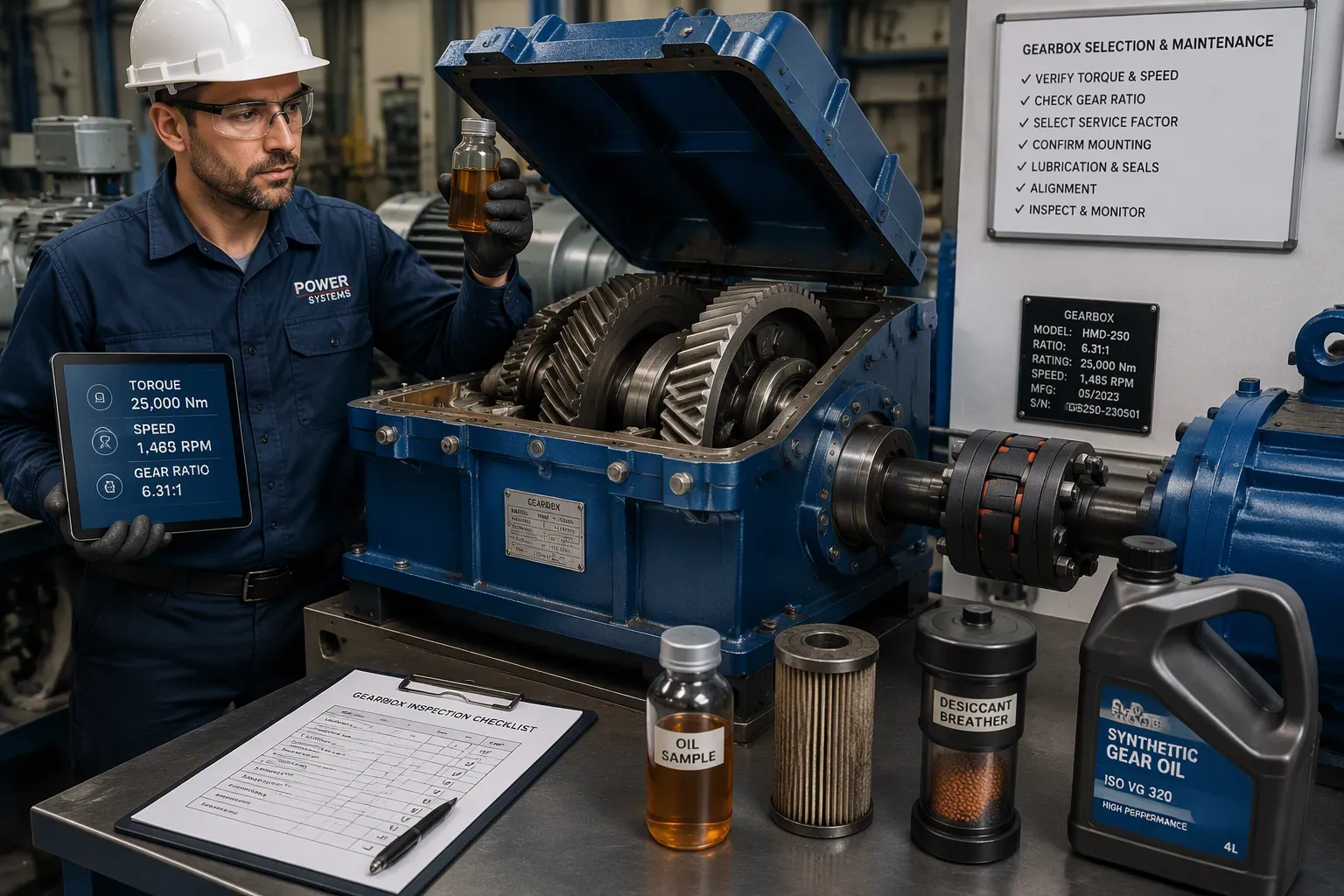
Contamination control is critical. Breathers, desiccants, and proper sealing prevent water and particle ingress. Operators should filter oil upon delivery and use inline filters during operation. Synthetic lubricants offer improved temperature stability, longer service intervals, and better oxidation resistance.
Oil analysis reveals internal wear, contamination, and lubricant degradation without stopping equipment. Core tests include spectrometric wear metal analysis, viscosity measurement, particle counting, and water content detection. Results guide oil change intervals based on actual condition rather than fixed schedules. Vibration monitoring and thermography complement oil analysis in a complete predictive maintenance program.
Southdrive supports these requirements with certified manufacturing expertise. The company holds ISO9001:2015, ISO14001:2015, and ISO45001:2018 certifications, and its 20,000 square meter self-owned factory uses advanced machinery from Gleason and HOFLER. Backed by more than 20 years of manufacturing experience and a skilled engineering team, the company produces custom aluminum castings and precision gears for global OEMs.
Industrial gearboxes keep oil and gas operations running, marine vessels moving, and cooling tower systems performing efficiently. Across all three sectors, these drives share the same core benefits: torque conversion, speed control, operational reliability, and long service life in demanding environments.
Proper selection and regular maintenance protect those benefits over time, and working with an experienced manufacturer adds further value. Certified quality and tailored engineering ensure each drive matches its real load, speed, and environmental conditions. That is what turns a component purchase into a long-term reliability strategy.
Need a Gearbox Built for Your Duty Cycle?
Send us your drawings, torque and speed requirements, and operating environment. Our engineering team will recommend the right drive — or design a custom one — with full material traceability, noise and vibration testing, and temperature-rise reports.
Request a Custom QuoteOr email info@czsouthdrive.com · WhatsApp +86-18114306795
FAQ
What makes industrial gearboxes suitable for oil and gas drilling operations?
The deciding factors are torque capacity, duty cycle, and traceability rather than horsepower alone. Drilling and mud pump drives run near-continuously under shock loading, so the gear set needs case-hardened alloy steel, a rigid housing, and a documented heat-treatment record for every part. Southdrive's Fracturing Pump Type 600 Gearbox is a working example: 448 kW rated power at a 4.61:1 speed ratio, with 18CrNiMo7-6 gearing in a welded Q235 steel housing. The matching fracturing pump gearbox gears are engraved with a serial number for the same reason.
Why are Klingelnberg spiral bevel gears preferred in marine gearboxes?
Spiral bevel gearing carries thrust and torque through a rolling contact rather than a sliding one, so it runs cooler and quieter than straight bevel gears at the same load. The Klingelnberg equal-height tooth form also spreads contact across the full tooth, which raises load capacity without adding size. Southdrive machines these gears to Grade 3 accuracy on Klingelnberg C100U machines using hard skiving, which is what delivers the low noise signature that marine propulsion and steering duty requires.
How do cooling tower gearboxes improve system efficiency?
A speed reducer lets the fan run at its aerodynamic design point while the motor stays at its efficient speed, which is where airflow per kilowatt peaks. Two design choices protect that efficiency over time: oil ports and cooling fins sized to hold oil temperature down, and case stiffness that prevents misalignment from eating into the tooth contact pattern. In practice, the biggest efficiency loss in a cooling tower drive is not the gear mesh itself but a fan that has drifted off balance or a lubricant that has degraded past its service window.
What certifications should buyers look for in a gearbox manufacturer?
Start with a quality management system, then ask for the evidence behind it. Southdrive holds ISO9001:2015, ISO14001:2015, and ISO45001:2018 certifications, and each shipment can be supported with material certificates, heat-treatment records, and noise, vibration, and temperature-rise test reports. Buyers should also confirm that the manufacturer performs its own gear grinding and heat treatment in house, because outsourced processes are where traceability usually breaks down.
How does Southdrive support custom gearbox requirements for global OEMs?
We work build-to-print from customer 2D and 3D drawings, or from a duty specification when drawings are not available. That covers gear and gearbox design, low-pressure and gravity aluminum castings, heat treatment, precision grinding, and final testing — from prototype to mass production. A 20,000 square meter self-owned factory and in-house testing equipment keep the development loop short, and 20+ years of manufacturing experience means most custom requests start from a proven design rather than a blank sheet.
Marine gearbox market figures are quoted from published industry research (Coherent Market Insights, Marine Gearbox Market, 2026). Product specifications refer to Southdrive's published technical data.
Please Contact Us!


Recent News
1.Precision Gears Compared: Spur vs Helical vs Bevel vs Worm
2026-09-042.How Hard Skiving Reduces NVH in Klingelnberg Spiral Gears
2026-09-213.How to Select the Right Gearbox for Oilfield Applications
2026-09-144.Internal Gear Ring Selection: 5 Tips for Precision Engineering
2026-09-075.What Are Straight Cut Gears and How Do They Work
2026-09-01